
Blog
7 Important Factors to Consider When Buying Dry Irons in Bulk

Buying dry irons in bulk involves more than comparing designs and prices. For electrical appliance brands, distributors, wholesalers and private-label businesses, the right product selection can directly influence customer satisfaction, repeat sales and brand reputation.
Dry irons may appear simple, but their performance depends on several important factors, including heating consistency, soleplate quality, temperature control, body construction and electrical components.
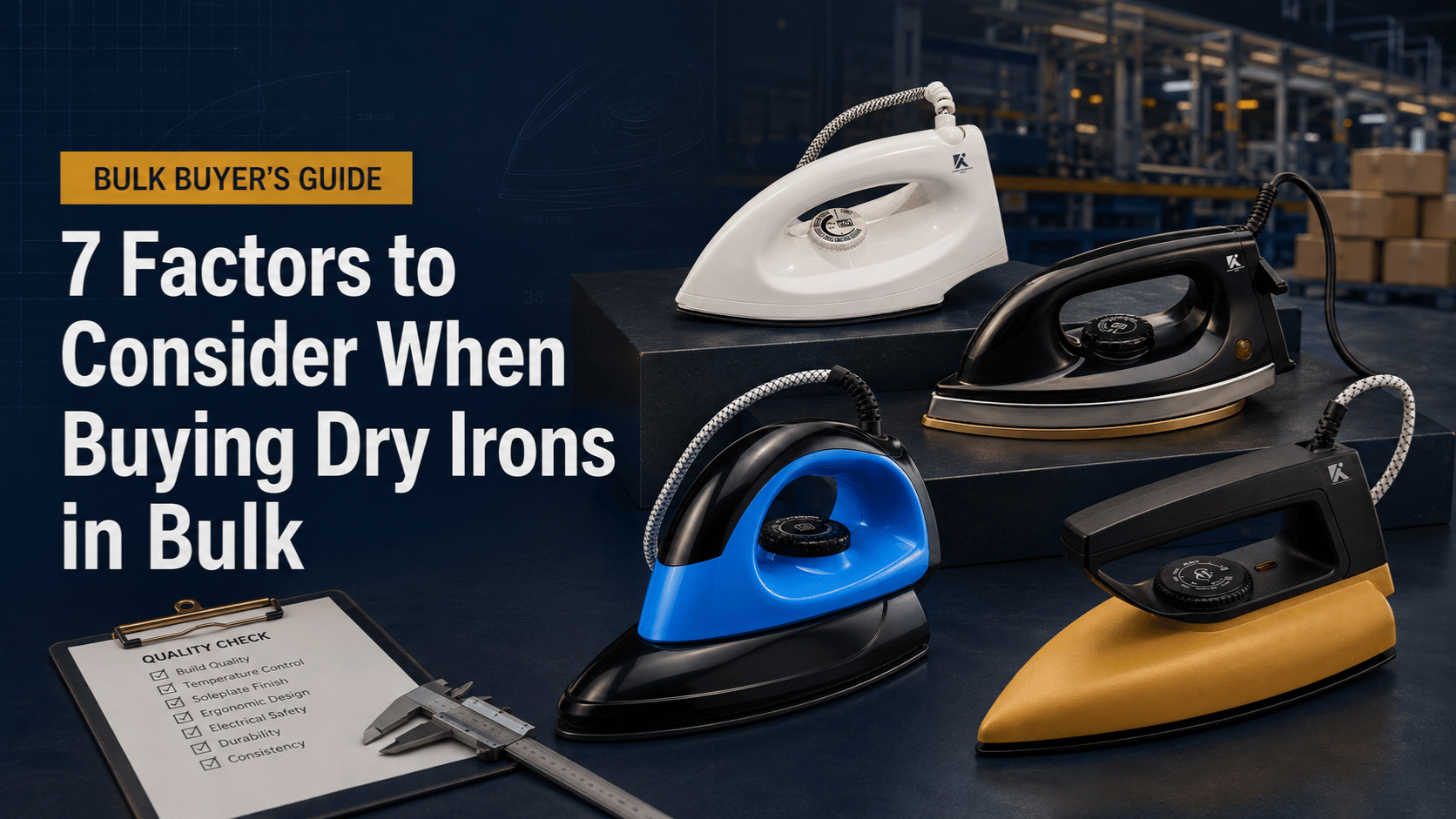
Before placing a bulk order, businesses should carefully evaluate the following seven factors.
1. Heating Performance and Wattage
Heating performance is one of the most important considerations when sourcing dry irons.
A well-designed dry iron should heat efficiently and distribute heat consistently across the soleplate. Uneven heating may affect ironing performance and lead to an unsatisfactory customer experience.
When reviewing a model, consider:
- Available wattage options
- Heating time
- Heat distribution
- Temperature stability
- Energy consumption
- Compatibility with the intended market
The ideal wattage depends on the product category, target customers and expected performance. Confirm all electrical specifications with the manufacturer before approving production.
2. Soleplate Material and Finish
The soleplate is the part of the iron that comes into direct contact with the fabric. Its material, surface finish and shape can affect heat transfer and movement across different fabrics.
Important factors include:
- Smoothness of the soleplate
- Heat distribution
- Resistance to everyday wear
- Shape of the soleplate
- Finishing quality
- Ease of movement over fabric
Check the sample carefully for rough edges, uneven finishing or surface irregularities.
The selected soleplate should support convenient ironing while remaining suitable for the product’s intended price category.
3. Temperature Control
An effective temperature-control system allows users to select suitable heat levels for different types of fabric.
When evaluating a dry iron, check:
- Movement of the temperature-control dial
- Clarity of temperature markings
- Range of available heat settings
- Thermostat response
- Stability at the selected setting
- Ease of operation
The temperature dial should be easy to access and operate. Its markings should also be clear enough for everyday users to understand.
For bulk manufacturing, dial design and markings should be confirmed before production.
4. Body Construction and Handle Design
A dry iron should be comfortable to hold and practical to use. The shape of the handle, overall balance and body construction all contribute to the user experience.
Evaluate the following:
- Handle comfort
- Product balance
- Overall weight
- Grip space
- Body finishing
- Joint alignment
- Strength of assembled components
- Placement of the temperature dial
A product that looks attractive but feels uncomfortable may not perform well in the consumer market.
Brands and distributors should select models that provide a suitable balance between design, comfort and durability.
5. Power Cord and Plug Quality
The power cord is a critical part of any electrical appliance. It should be suitable for regular movement and should connect securely to the iron.
Important points to review include:
- Cord length
- Cord material
- Flexibility
- Strain-relief construction
- Connection with the iron body
- Plug type
- Pin quality
- Suitability for the target market
For products intended for the Indian market, businesses should confirm the required Indian plug configuration and applicable product specifications.
The cord should be long enough for convenient use without appearing excessively short. Confirm the approved cord colour, length and plug design before bulk production.
6. Quality Consistency Across Bulk Orders
A product sample may appear satisfactory, but businesses must also consider whether the same quality can be maintained throughout a large production order.
Consistency should be evaluated across:
- Product dimensions
- Body colour
- Surface finishing
- Soleplate alignment
- Temperature controls
- Cord length
- Plug configuration
- Packaging
- Branding placement
Ask the manufacturer about its production and inspection processes. Clear specifications and approved reference samples can help reduce variations during bulk manufacturing.
Businesses should document all agreed details before confirming the final order.
7. OEM Customisation and Packaging Support
For private-label brands, the ability to customise the product and packaging can be an important purchasing factor.
Depending on feasibility and order quantity, OEM options may include:
- Product model
- Body colour
- Decorative finishes
- Soleplate options
- Temperature-dial design
- Cord colour and length
- Branding placement
- Product labels
- Inner packaging
- Master cartons
- Instruction materials
Packaging should protect the product during storage and transportation while communicating the brand clearly at the point of sale.
Before placing an order, confirm which elements are standard and which are customisable. Also discuss minimum order quantities and any additional development requirements.
Additional Factors Bulk Buyers Should Check
Along with the seven key factors, buyers should discuss several commercial considerations with the manufacturer.
Minimum Order Quantity
Confirm the minimum quantity required for standard and customised models. Custom colours, branding and packaging may require different order quantities.
Production Lead Time
Ask for a realistic manufacturing timeline, especially when preparing for seasonal demand or a planned product launch.
Sample Approval
Always evaluate and approve the relevant sample before confirming bulk production. Record approved colours, specifications and packaging details.
Product Testing Requirements
Discuss the inspection process, required documentation and applicable compliance requirements for the intended market.
Repeat-Order Capability
Consider whether the manufacturer can maintain agreed specifications and support increasing order quantities as your business grows.
After-Sales Coordination
Clarify how manufacturing concerns, repeat orders and product-related communication will be handled after dispatch.
Questions to Ask a Dry Iron Manufacturer
Before placing a bulk order, ask the following questions:
- Which dry iron models are available?
- What wattage options can be offered?
- Which soleplate materials and finishes are available?
- What temperature-control system is used?
- Which body colours can be selected?
- What cord lengths and plug configurations are available?
- Can the product carry our brand name?
- Is custom packaging available?
- What is the minimum order quantity?
- What is the estimated production lead time?
- How is consistency maintained across bulk orders?
- Can the facility support repeat and larger orders?
Clear answers will help you compare manufacturers and select the most suitable sourcing partner.
Common Mistakes to Avoid
When purchasing dry irons in bulk, avoid these common mistakes:
- Selecting a product based only on price
- Approving the design without testing its handling
- Ignoring cord length and plug configuration
- Failing to document product specifications
- Confirming packaging without checking product protection
- Assuming every detail can be customised
- Placing a large order without approving a relevant sample
- Choosing a supplier without evaluating manufacturing capacity
A structured buying process can reduce misunderstandings and help protect your business investment.
Why Source Dry Irons from Khush Industries?
Founded in 1998, Khush Industries (India) is an experienced OEM manufacturer of electrical appliances specialising in dry irons and immersion rods.
From its beginnings as a trading business in Madurai, the company transitioned into manufacturing and gradually expanded its capabilities. Today, Khush Industries operates from a modern 30,000 sq. ft. manufacturing facility in Ahmedabad, Gujarat.
Our dry iron manufacturing capabilities include:
- Multiple product designs
- Different colour and finish possibilities
- In-house die development
- Process-driven manufacturing
- OEM and private-label support
- Branding and packaging coordination
- Bulk production capabilities
- Support for distributors, wholesalers and growing brands
Product customisation is subject to technical feasibility, order quantity and mutually approved specifications.
Conclusion
When buying dry irons in bulk, businesses should carefully evaluate heating performance, soleplate quality, temperature control, body construction, cord and plug quality, production consistency and OEM customisation options.
The right product should meet customer expectations while supporting your brand’s quality standards, positioning and pricing strategy.
Most importantly, choose a manufacturer that understands your requirements, communicates clearly and has the infrastructure to support your long-term growth.