
Blog
How to Choose the Right OEM Manufacturer for Electrical Appliances

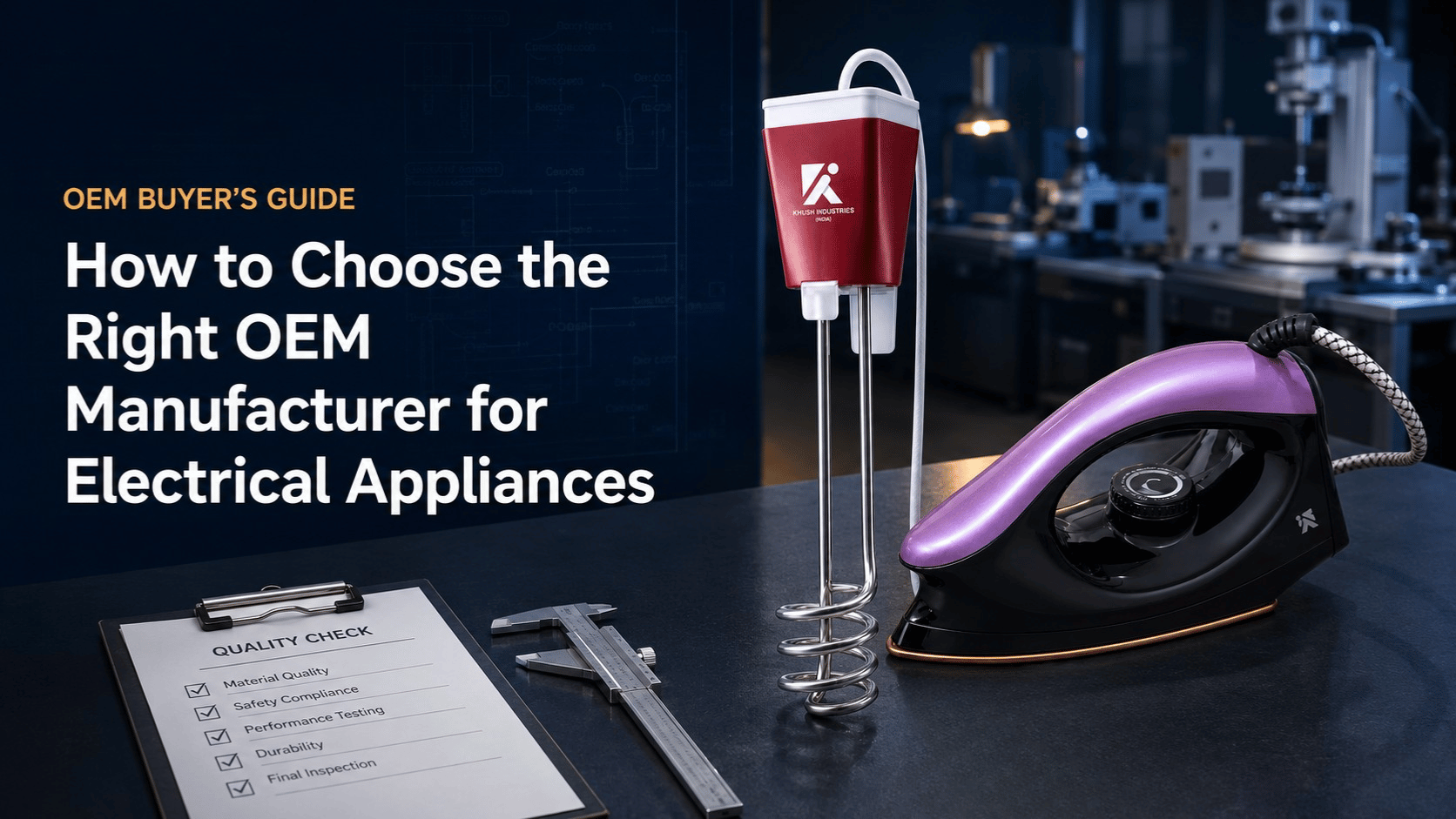
Choosing the right OEM manufacturer is an important decision for any electrical appliance brand. Your manufacturing partner influences product quality, supply consistency, pricing, customer satisfaction and ultimately your brand’s reputation.
Whether you are launching a new electrical appliance brand or expanding an existing product range, you need a manufacturer who understands your commercial requirements and can deliver dependable products consistently.
Here are the most important factors to consider when selecting an OEM manufacturer for electrical appliances.
What Is an OEM Manufacturer?
OEM stands for Original Equipment Manufacturer. An OEM manufacturer produces products according to the requirements of another company, which then sells those products under its own brand.
Depending on the arrangement, an OEM partner may support:
- Product selection and development
- Design and colour customisation
- Technical specifications
- Component selection
- Branding and private labelling
- Packaging development
- Bulk production
- Quality inspection
Working with an experienced OEM manufacturer allows businesses to introduce products without establishing and managing their own manufacturing facility.
1. Evaluate the Manufacturer’s Industry Experience
Manufacturing experience is one of the first things a business should evaluate.
An experienced manufacturer is more likely to understand product requirements, component compatibility, manufacturing challenges and changing market expectations. Industry experience can also help the manufacturer identify practical solutions during product development.
Before choosing an OEM partner, consider:
- How long has the company been operating?
- Which products does it specialise in?
- Does it understand the intended market?
- Does it have experience with bulk production?
- Can it support long-term business requirements?
A manufacturer with relevant product experience can provide more dependable support than a general supplier with limited technical knowledge.
2. Check Product Specialisation
Not every electrical appliance manufacturer has expertise across all product categories. Choosing a manufacturer with focused experience in your required product can improve manufacturing efficiency and product consistency.
For example, when sourcing dry irons, the manufacturer should understand:
- Heating performance
- Temperature control
- Soleplate design
- Handle comfort
- Body construction
- Electrical components
- Product finishing
Similarly, an immersion rod manufacturer should understand heating elements, wattage options, insulation, construction and practical usage requirements.
Relevant product expertise is especially important when developing private-label appliances.
3. Understand the Manufacturing Infrastructure
A manufacturer’s infrastructure determines its ability to handle production volume, maintain organised processes and support future growth.
Evaluate whether the facility has sufficient space and suitable systems for:
- Product development
- Component storage
- Manufacturing
- Assembly
- Inspection
- Packaging
- Finished-product storage
A well-organised manufacturing facility is generally better positioned to manage bulk requirements and maintain production consistency.
Businesses should also consider whether the manufacturer can scale production as their sales network grows.
4. Look for In-House Product Development Capabilities
In-house product development can provide greater control over design, accuracy and manufacturing timelines.
A manufacturer with in-house die development can support:
- Distinctive product designs
- Better dimensional consistency
- Product modifications
- Component compatibility
- Faster design improvements
- Reduced dependence on external suppliers
This capability can be particularly valuable for brands that want to differentiate their products in a competitive market.
5. Review Product Quality and Consistency
A good sample is important, but maintaining the same quality across bulk production is equally essential.
Ask the manufacturer about its quality-focused processes at different stages, including:
- Component selection
- Production
- Assembly
- Electrical construction
- Functional inspection
- Product finishing
- Final packaging
Consistent manufacturing helps reduce product variation and protects the reputation of the brand selling the finished appliance.
Product specifications and applicable testing requirements should be discussed clearly before confirming an order.
6. Discuss OEM Customisation Options
Different brands have different markets, price points and customer expectations. Therefore, the manufacturer should be able to discuss suitable customisation possibilities.
Depending on feasibility and order quantity, OEM options may include:
- Product models
- Colours and finishes
- Wattage options
- Component configurations
- Brand name placement
- Product labels
- Instruction materials
- Inner and outer packaging
Before production begins, both parties should confirm which aspects are standard and which can be customised.
Clear documentation helps avoid misunderstandings during bulk manufacturing.
7. Confirm Production Capacity and Lead Times
Before selecting a manufacturer, confirm whether its production capacity matches your current and expected order requirements.
Important questions include:
- What is the minimum order quantity?
- What production volume can the facility manage?
- What is the expected manufacturing lead time?
- How does the manufacturer handle repeat orders?
- Can production increase if market demand grows?
- What information is required before production begins?
A dependable OEM partner should communicate realistic production timelines rather than making commitments that may be difficult to maintain.
8. Evaluate Communication and Business Support
Effective communication is essential in an OEM relationship.
The manufacturer should understand your specifications, respond to important questions and clearly explain product possibilities and limitations.
Good communication becomes particularly important during:
- Product selection
- Sample development
- Specification approval
- Packaging finalisation
- Production updates
- Dispatch coordination
- Repeat orders
An OEM partnership is more effective when both parties communicate openly and maintain clear records of approved requirements.
9. Compare Value, Not Just Price
The lowest quotation is not always the best option.
Product cost may be influenced by components, materials, specifications, finishing, order quantity, packaging and customisation. A very low price may sometimes involve compromises that affect product performance or consistency.
When comparing manufacturers, evaluate the overall value offered through:
- Manufacturing experience
- Product quality
- Development capabilities
- Production consistency
- Communication
- Supply reliability
- Customisation support
A dependable product can create better long-term value than a cheaper product that leads to complaints, returns or reputational damage.
10. Think About Long-Term Partnership Potential
A strong OEM relationship should support the future growth of your business.
Instead of choosing a supplier for only one order, consider whether the manufacturer can support:
- Repeat production
- New product models
- Design improvements
- Additional colour options
- Packaging updates
- Increasing order volumes
- Changing market requirements
A long-term manufacturing partner understands your business better over time and can help create a more stable supply chain.
Questions to Ask Before Finalising an OEM Manufacturer
Before making your decision, ask the manufacturer:
- How much experience do you have with this product category?
- Which product models and specifications are available?
- Do you provide OEM or private-label support?
- Which elements of the product can be customised?
- Do you have in-house die development?
- What is your minimum order quantity?
- What is the expected production lead time?
- How do you maintain consistency across bulk orders?
- Can you support custom branding and packaging?
- Can your facility support our future growth?
These questions will help you compare potential manufacturers more effectively.
Why Consider Khush Industries (India)?
Founded in 1998, Khush Industries (India) is an OEM manufacturer specialising in dry irons and immersion rods.
From its beginnings as a trading business in Madurai, the company transitioned into manufacturing in Delhi and later expanded its product portfolio. Today, Khush Industries operates from a 30,000 sq. ft. manufacturing facility in Ahmedabad, Gujarat.
Its key capabilities include:
- More than two decades of industry experience
- Specialisation in dry irons and immersion rods
- In-house die development
- Skilled manufacturing workforce
- Multiple product options
- OEM and private-label support
- Scalable production infrastructure
- B2B-focused manufacturing solutions
Khush Industries works with brands, distributors, wholesalers and bulk buyers seeking dependable electrical appliance manufacturing support.
Conclusion
Choosing the right OEM manufacturer requires more than comparing product prices. Industry experience, product expertise, manufacturing capabilities, quality consistency, customisation support and communication should all be considered.
A reliable manufacturing partner does more than supply products—it supports your brand’s reputation, market growth and long-term success.
If you are looking for an OEM manufacturing partner for dry irons or immersion rods, connect with Khush Industries (India) to discuss your product, branding and bulk-order requirements.
Business Enquiry
Khush Industries (India)
Avdhesh Industrial Hub, Bhavda,
Ahmedabad, Gujarat – 382430
Phone: +91 99999 54756
Alternate Phone: +91 85951 97972