
Blog
How In-House Die Development Improves Product Quality and Consistency

For an electrical appliance manufacturer, product quality is not decided only during final assembly. It begins much earlier—at the product-design and tooling stage.
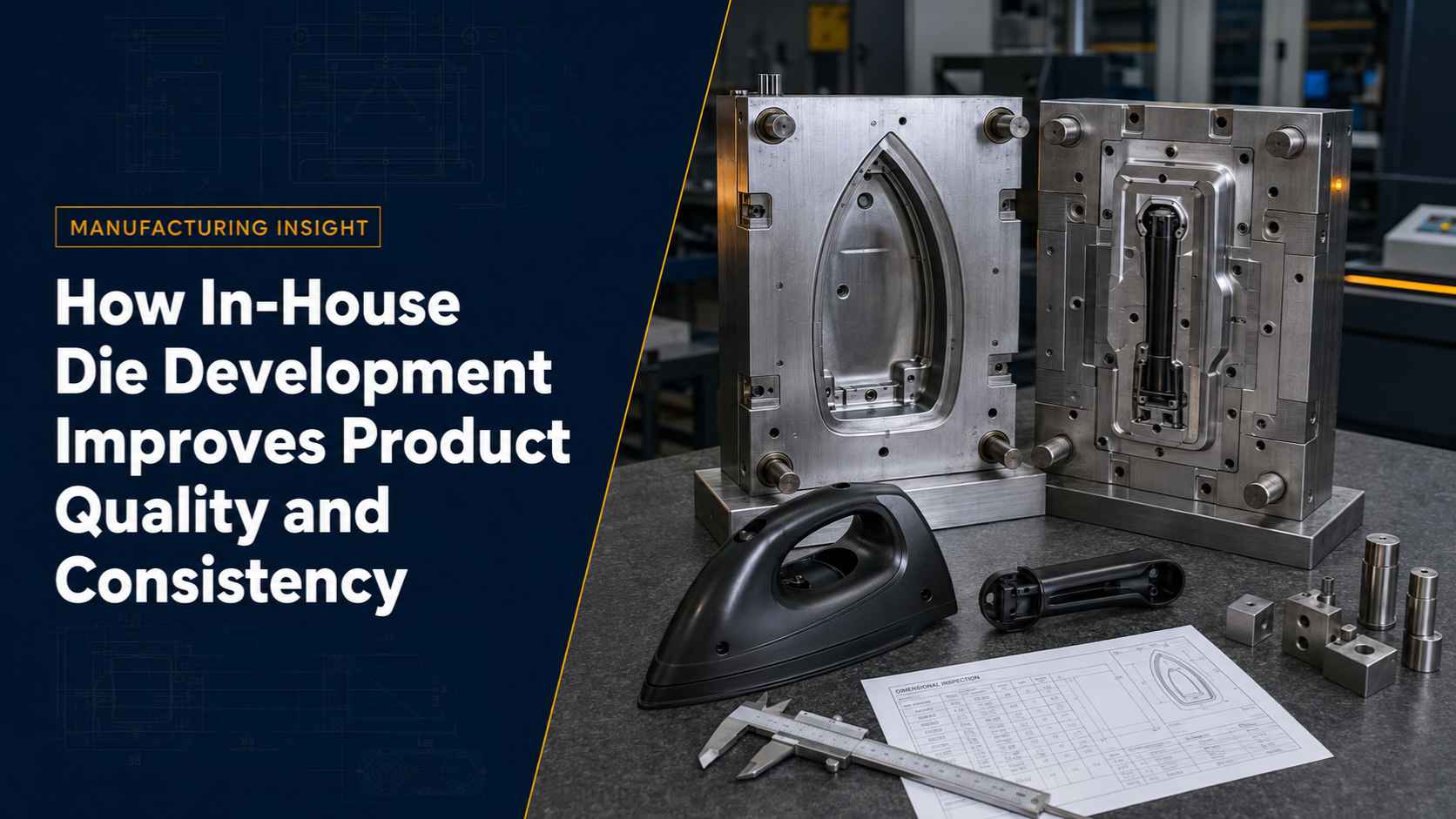
Die development plays an important role in creating product components with accurate shape, fit and repeatability. When die development is managed in-house, manufacturers can maintain greater control over product design, production consistency and improvement processes.
For brands, distributors, wholesalers and private-label businesses, this can make a meaningful difference in the appearance, performance and reliability of the final product.
What Is Die Development?
A die is a specialised production tool used to form, shape or manufacture product components with consistent dimensions.
In electrical appliance manufacturing, dies can support the development of components such as:
- Outer product bodies
- Plastic housings
- Handles
- Covers and panels
- Component supports
- Metal parts
- Product fittings
- Assembly-related components
The exact type of die depends on the product design, material and manufacturing process.
Once a die is developed and approved, it helps the manufacturer produce similar components repeatedly with greater consistency.
Why In-House Die Development Matters
When die development is managed in-house, a manufacturer has more direct control over the product-development process.
Instead of relying entirely on external tooling suppliers, the manufacturing team can review designs, identify practical concerns and make improvements more efficiently.
This can support:
- Better design control
- Faster product development
- Improved component fit
- More consistent production
- Easier design modifications
- Reduced dependency on outside processes
- Better coordination between design and manufacturing teams
For OEM customers, this capability can be especially valuable when discussing product models, design changes or market-specific requirements.
1. Improved Product Design Control
In-house die development allows manufacturers to study product design more closely before bulk production begins.
The production team can evaluate whether the design is practical to manufacture, assemble and finish. If a component requires adjustment, the manufacturer can review the issue directly with the relevant team.
This helps improve important aspects such as:
- Product shape
- Handle design
- Component placement
- Assembly fit
- Surface finish
- Structural balance
- Compatibility between parts
For electrical appliances such as dry irons and immersion rods, component design can influence both product appearance and day-to-day usability.
2. Better Component Accuracy
Product components need to fit together correctly. Even a small variation in size or shape can affect assembly quality, surface alignment or product finishing.
A properly developed die helps manufacturers produce components with more uniform dimensions.
This can support:
- Better alignment of assembled parts
- More consistent body shape
- Cleaner joints
- Improved fitting between components
- Reduced visible gaps
- More professional product finishing
Accuracy is important not only for product appearance but also for maintaining manufacturing efficiency during bulk production.
3. Greater Consistency Across Bulk Orders
One of the most important benefits of die development is repeatability.
Once an approved die is used in production, it helps create similar components across larger quantities. This is particularly important for brands and distributors that expect the same product design and finishing across every order.
Consistent tooling can help maintain:
- Similar product dimensions
- Consistent component shape
- Uniform body design
- Better colour application on matching parts
- Predictable assembly
- Standardised product appearance
For a business selling products under its own brand, consistency supports customer trust and reduces the risk of variation between batches.
4. Faster Product Development and Improvement
In-house capabilities can make it easier to review, modify and improve product components during development.
For example, if a design requires changes related to grip, shape, component fitting or visual appearance, the manufacturer can coordinate internally instead of depending entirely on an outside tooling process.
This may support:
- Faster evaluation of design changes
- Improved sample development
- Product-model updates
- Better response to market feedback
- More efficient coordination between teams
- Practical design refinement
The final timeline still depends on technical complexity, tool requirements and approval processes, but in-house support can improve overall coordination.
5. Supports Distinctive Product Designs
In competitive electrical appliance markets, product design can help a brand stand out.
In-house die development gives manufacturers more flexibility to explore distinctive product shapes, handle styles, body designs and component arrangements.
For OEM and private-label businesses, this can support product differentiation through:
- Different body shapes
- Unique colour combinations
- Handle variations
- Product profile changes
- Design-focused finishes
- Brand-specific product appearance
All design changes should be evaluated for manufacturing feasibility, safety considerations, cost and order quantity before they are finalised.
6. Better Coordination Between Design and Production
Product development works best when the design team and production team communicate closely.
In-house die development supports this collaboration because teams can review design requirements alongside actual manufacturing conditions.
This makes it easier to identify issues before large-scale production begins, such as:
- Difficult component assembly
- Material limitations
- Shape-related concerns
- Surface-finishing challenges
- Tooling adjustments
- Part-fit issues
Early review can help reduce avoidable production challenges and support a smoother manufacturing process.
7. Supports Long-Term OEM Partnerships
OEM customers often need more than a standard product. They may require specific colours, model options, branding placements or packaging requirements.
A manufacturer with in-house die development is generally better positioned to discuss product-development possibilities with a long-term perspective.
This can support:
- New model development
- Product design modifications
- Improved repeat-order consistency
- Brand-focused product planning
- Market-specific product options
- Long-term product portfolio growth
For businesses building their own appliance brand, a capable OEM partner can become an important part of their product strategy.
How Die Development Supports Dry Iron Manufacturing
In dry iron manufacturing, die development can influence the shape and quality of several product components.
Possible areas include:
- Outer body design
- Handle construction
- Temperature-dial housing
- Rear cover
- Cord-entry area
- Product base support
- Component-fitting sections
A well-developed tool can help maintain a consistent product profile and improve the fitting of different body components.
This supports a finished product that looks professional, feels practical to use and remains consistent across bulk orders.
How Die Development Supports Immersion Rod Manufacturing
In immersion rod manufacturing, tooling and component-development processes can support the construction of product housings, handles, cable-entry sections and other assembled components.
The result can support:
- Consistent handle shape
- Reliable component fit
- Better external finishing
- Product-model variation
- Brand-focused design options
- Improved assembly coordination
The heating element, electrical components and product specifications should always be reviewed separately according to the selected model and applicable requirements.
Questions Businesses Should Ask an OEM Manufacturer
When selecting an OEM manufacturer, businesses can ask:
- Do you have in-house die-development capabilities?
- Which product components can be developed or modified?
- Can you support new product models?
- What design options are available?
- How are product samples approved before bulk production?
- How is consistency maintained across repeat orders?
- What minimum order quantity is required for custom development?
- How does tooling affect product-development timelines?
- Can the product body or handle colour be customised?
- How are technical and design changes documented?
Clear discussions at the beginning of a project help both the manufacturer and buyer set practical expectations.
Important Considerations Before Developing a Custom Product
Custom product development should be approached carefully. Before beginning, businesses should confirm:
- Target customer segment
- Product positioning
- Required design features
- Product colour and finish
- Expected order quantity
- Packaging requirements
- Budget considerations
- Timeline expectations
- Technical feasibility
- Product approval process
A detailed product brief helps the manufacturer understand the business requirement and recommend suitable options.
Why Choose Khush Industries (India)?
Khush Industries (India) is an experienced OEM manufacturer of dry irons and immersion rods.
Founded in 1998, the company has grown from a trading business in Madurai into a modern manufacturing operation in Ahmedabad, Gujarat. Today, we operate from a 30,000 sq. ft. manufacturing facility and support businesses looking for dependable electrical appliance manufacturing solutions.
Our strengths include:
- More than 25 years of industry experience
- In-house die development
- Specialisation in dry irons and immersion rods
- Skilled manufacturing workforce
- Process-driven production
- Product design support
- OEM and private-label capabilities
- Bulk manufacturing infrastructure
- Consistent supply support for brands and distributors
Customisation possibilities depend on product feasibility, order quantity and mutually approved specifications.
Conclusion
In-house die development is an important capability for manufacturers that want to improve product accuracy, consistency and design control.
For OEM customers, it can support better product development, reliable bulk production and more practical design flexibility.
When choosing an electrical appliance manufacturer, businesses should evaluate not only the available product models but also the manufacturer’s ability to support long-term product quality and improvement.
Khush Industries (India) combines industry experience, in-house die development and scalable manufacturing capabilities to support brands, distributors and bulk buyers with dependable dry irons and immersion rods.